
The Button Ring: A History of Old Hollywood's Boldest Statement
Some women wear jewelry. Other women are wearing the room. The button ring belongs to the second category.
There is a particular kind of ring that does not whisper. It is not delicate. It is not subtle. It is not the kind of piece that disappears into a stack on a casual Tuesday or hides behind a sweater cuff in a meeting. It is, in every sense of the phrase, a statement — wide, deliberate, polished, and unapologetic about taking up space on a hand.
This is the button ring. And no piece of jewelry in the 20th century said more about the woman wearing it.
What Is a Button Ring?
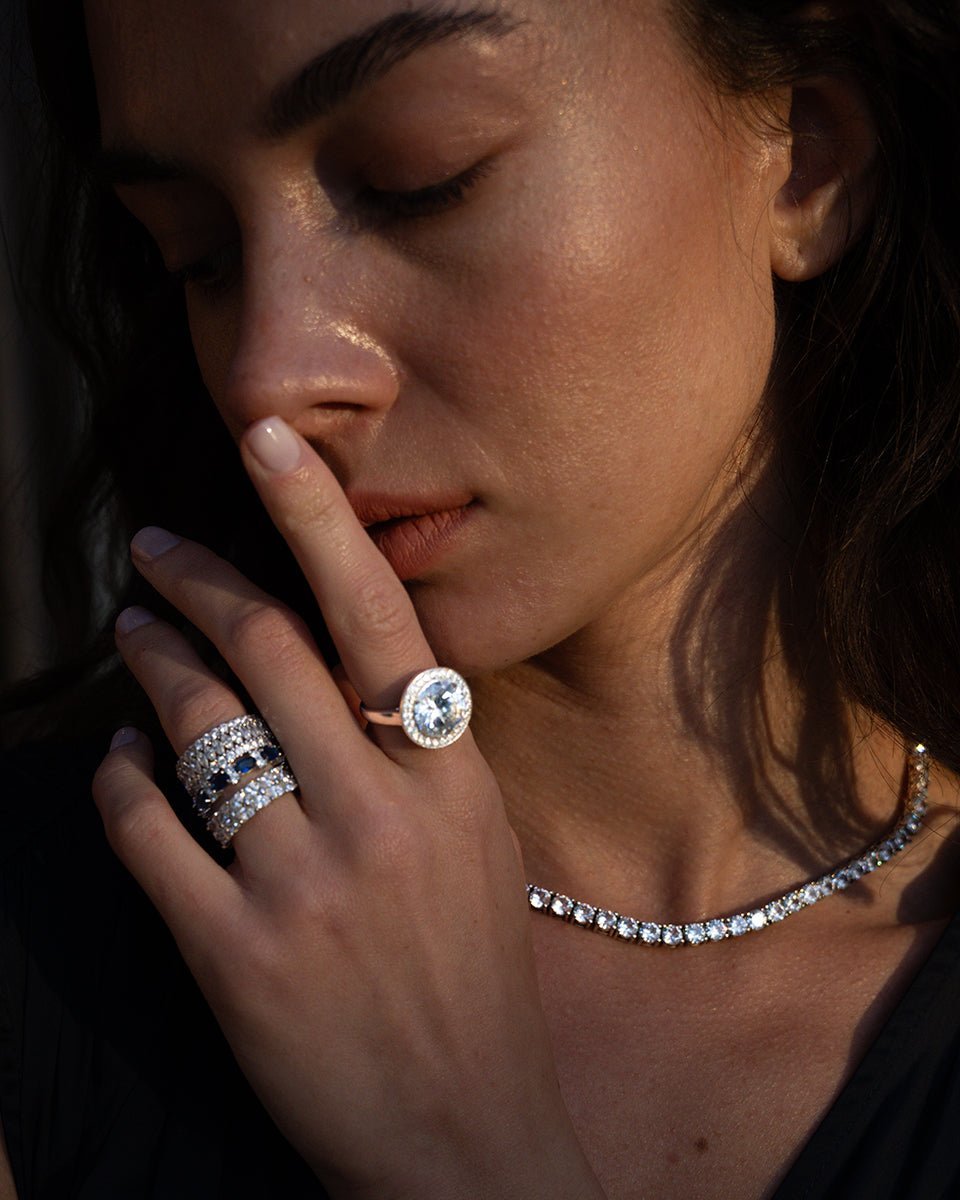
A button ring is exactly what the name suggests: a ring with a flat, disc-shaped face, wide enough to resemble a substantial decorative button. The face is most often round, occasionally oval, and almost always centered on a single dominant stone — typically circled by a halo of smaller stones that frame the center and amplify its brilliance. The overall silhouette is bold, low-profile rather than tall, and confidently architectural.
The button ring belongs to the broader family of cocktail rings — a category of oversized, decorative rings designed to be seen across a candlelit room, not examined up close. But within that family, the button ring is the most disciplined form. Where some cocktail rings layer color, mix cuts, or build vertically with elaborate settings, the button ring keeps it simple: one striking center stone, one elegant halo, one clean disc-shaped face.
The result is a ring that looks deceptively simple and is impossibly difficult to do well.
A Brief History of the Cocktail Ring (and Where the Button Fits In)
The button ring's story begins, oddly enough, with Prohibition.
In 1920, the United States outlawed the sale of alcohol — and almost immediately, an entire underground social culture rose up around the speakeasy. Cocktail parties, until that moment a relatively quiet domestic affair, became something else entirely: glamorous, illicit, dimly lit gatherings where women in dropped-waist dresses sipped illegal gin from coupe glasses and held court like they owned the room.
These women needed jewelry that worked in candlelight. Subtle pieces disappeared in the speakeasy haze. The solution was the cocktail ring — a deliberately oversized statement piece that caught the dim light, glittered when she lifted her glass, and announced her presence the moment she entered. By the late 1920s, the cocktail ring was the defining accessory of an entire generation of modern women.
Then came the 1930s and the golden age of Hollywood, which took the cocktail ring and elevated it into something mythic. Studio lighting was designed to be reflected, and a substantial ring on the right hand of the right woman — Greta Garbo, Marlene Dietrich, Bette Davis — could carry an entire close-up. Costume designers and studio jewelers began producing rings specifically for the way they would photograph: large, faceted, dramatic, seen.
By the 1940s and 50s, the button ring had emerged as one of the dominant cocktail ring forms. Its low profile made it practical (it didn't catch on gloves or fabric), its wide disc face was visually substantial (perfect for the camera), and its symmetry photographed cleanly from any angle. It became the ring you saw on a movie poster, on a magazine cover, on the cover of Life magazine in 1953.
And no actress wore the button ring with more conviction than Joan Crawford.
Joan Crawford and the Ring That Named Itself
Joan Crawford did not believe in small jewelry. Across more than 80 films and four decades of Hollywood, she was almost never photographed without a substantial ring — usually a button or domed cocktail ring, often more than one at a time, frequently swapped between scenes by her personal jeweler.
There is a famous story about Crawford from the set of Mildred Pierce in 1945, the film that won her an Academy Award. A studio photographer asked her to remove her rings before a publicity still. She refused. "Without my jewelry," she reportedly said, "I'm not Joan Crawford. I'm just a woman from Texas."
This is the kind of woman the button ring was made for — a woman who understood that jewelry isn't decoration, it's punctuation. A woman who made deliberate choices about how she wanted to be seen. A woman who knew that the right ring on the right hand at the right moment was a kind of authorship.
The Crawford ring at Godfrey Allure is named in her honor — and in the spirit of every woman who has ever chosen to walk into a room rather than tiptoe through it.
The Crawford: An Old Hollywood Silhouette in Sterling Silver
The Crawford is a button ring in the truest 1940s sense. A substantial 12mm round Allyure Stone™ sits at the center, surrounded by a halo of precision-cut smaller stones — together forming the wide, disc-shaped face that defined the cocktail ring era. Crafted in solid 925 sterling silver and set by hand, it is the kind of piece that draws light from across a candlelit table and holds it.
A 12mm center stone is not subtle. For perspective, that's roughly the diameter of a 6-carat round diamond — substantial enough to read as fine jewelry from a distance, weighty enough on the hand that you'll feel it, present enough that the ring becomes part of how the wearer moves.
The halo amplifies the center stone the way a perfectly placed mirror amplifies a candle. Light catches the outer stones first, draws the eye inward, and lands on the brilliant white center. Hand gestures become events. A reach for a wine glass becomes a small piece of theater.
This is the ring you put on when you want the rest of your outfit to step back and let your hand do the talking.
Who Wears a Button Ring?
A substantial ring is not for everyone, and we won't pretend otherwise. There are women who feel most themselves in delicate, layered, almost invisible jewelry. There are women who like the negotiated quietness of small studs and a thin chain.
The button ring is for the other woman.
She is the woman who knows the difference between attention and presence, and prefers the second. She is not loud — she does not need to be. The ring does that work for her. She walks into a dinner, lifts her glass, and the room reorganizes itself around her hand without anyone quite knowing why.
She is, in some essential way, post-permission. She has stopped asking whether her jewelry is "too much" or whether she should "tone it down." She has decided that the woman she is — the woman she has spent decades becoming — gets to wear what she wants. And what she wants is something substantial. Something with weight. Something that takes up the space she has earned.
She is, in other words, exactly the kind of woman Joan Crawford understood.
How to Style the Crawford
A button ring of this size demands a styling philosophy: let it lead. The Crawford is the loudest piece of jewelry on any hand it occupies, and the entire outfit should defer to it. Here's how to do it well.
What to Wear It With
Eveningwear that gets out of its way. A black sheath dress, a slip dress in champagne or navy, a tuxedo-style jumpsuit. Clean lines, simple silhouettes, a single neckline shape. The dress is the canvas; the ring is the painting.
Solid, rich colors. The Crawford reads beautifully against deep jewel tones — emerald, sapphire, oxblood, midnight — and against the classic neutrals (black, white, cream, camel). Patterns and prints fight it. Solids let it shine.
Long sleeves with cuffs. A long-sleeve dress or blouse with a clean cuff frames the hand and turns the ring into the focal point of the entire arm. This is the secret styling move of women who wear substantial rings well.
A simple manicure. A nude, soft pink, deep red, or chocolate brown polish. Avoid heavily embellished nails — they compete with the ring for attention, and the ring will always win, but the conflict will look chaotic.
A coordinated bracelet, optional. A delicate sterling silver tennis bracelet on the same hand picks up the ring's stones without challenging it. Avoid stacked bracelets or anything substantial on the same wrist — too much volume on one side of the body.
What NOT to Wear It With
Other large rings on the same hand. The Crawford is a soloist, not a chorus member. A simple wedding band on another finger is fine — anything more competes.
A statement necklace. Pick one focal point per outfit. If the ring is leading, the neck should rest. A simple chain or nothing at all.
Busy patterns or floral prints. The button ring is graphic. It needs visual quiet around it.
Small daytime bags with elaborate hardware. A simple clutch in a solid color is the right pairing. Save the busy bags for an outfit where the jewelry is less prominent.
When to Wear It
A button ring this substantial is, traditionally, an evening piece — born in cocktail hour, raised in the candlelit dining room. It belongs at dinners, at galas, at theater openings, at the kind of milestone evenings that deserve a story.
But the modern truth is that women have stopped asking permission about when their jewelry is "appropriate." The Crawford can be worn to a Sunday brunch with a white t-shirt and jeans, the contrast deliberate, the styling unapologetic. It can be worn to a Wednesday lunch with a navy blazer. It can be worn to a Saturday afternoon at the museum, paired with a cashmere turtleneck and a long camel coat.
The right time to wear a button ring is the time you decide to wear it.
A Final Word on Substance
There is something about a substantial ring that other jewelry doesn't quite manage. A delicate piece can be lovely. A tasteful piece can be admired. But a substantial ring on a confident hand has a quality that is harder to name — a kind of gravitational pull, the sense that the woman wearing it has decided something about herself and is no longer interested in negotiating it.
This is what Joan Crawford understood. This is what the women of the cocktail era understood. And this is what the woman who chooses the Crawford understands when she slides it onto her finger and looks at her own hand, perhaps for a moment longer than usual, before walking out the door.


Leave a comment
This site is protected by hCaptcha and the hCaptcha Privacy Policy and Terms of Service apply.