
Article: How to Stack Rings (And Which Pieces Actually Work Together)
How to Stack Rings (And Which Pieces Actually Work Together)

The ring stack is everywhere right now. Four fingers, seven rings, no apparent logic — and somehow it works on everyone who does it correctly.
The key word is correctly. Because a ring stack done well looks collected, effortless, like pieces that found each other over time. A ring stack done wrong looks like you grabbed everything in the drawer on the way out.
The difference is almost never about how many rings. It's about the anchor.
Start With One Ring That Means It
Every good stack begins with a piece that carries the weight — a ring with presence, with a real stone, with enough visual authority to organize everything around it. Without an anchor, you have accumulation. With one, you have a stack.
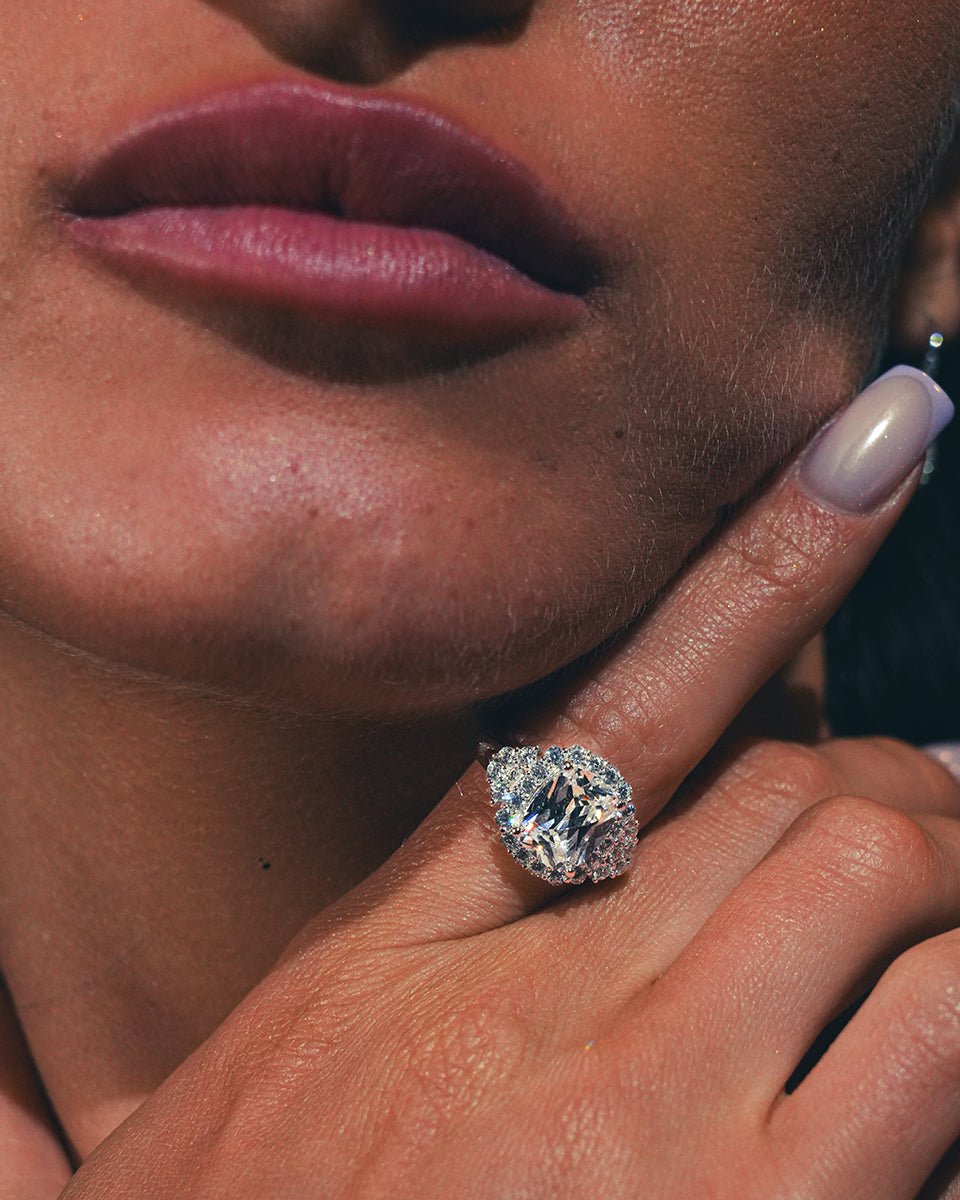
The Crawford Ring is built for this. An Old European cut Allyure Stones™ solitaire in a cathedral setting, finished in 925 sterling silver. The Old European cut — the hand-cut stone shape that preceded the modern brilliant — catches light with more warmth than a contemporary cut, which means it reads clearly even when surrounded by other rings.
Put the Crawford on your middle or ring finger. Build from there.
🛍 Crawford Ring — Old European Cut
Shop the Crawford →
The Contrast Piece
Once you have an anchor, the second ring should do something different — different cut, different silhouette, adjacent finger. Not matching. Rhyming.
The Hedda Ring is the natural contrast to the Crawford. Where the Crawford is a clean round solitaire, the Hedda features an Old Mine cut — the predecessor to the Old European, with slightly more cushion geometry and a deeper, more antique quality. The two cuts are related but distinct. On adjacent fingers they create a conversation rather than a repetition.
Stack them on the same hand with a bare finger between them and the effect is deliberate without being matched. That gap matters — it gives each ring room to be seen.
🛍 Hedda Ring — Old Mine Cut
Shop the Hedda →
The Rules (And When to Break Them)
Keep metals consistent. A stack in all sterling silver reads as intentional. Mixed metals can work, but it requires more precision to avoid looking accidental. When starting out, stay in one metal family.
Vary the profile. A solitaire, a thin band, and a slightly wider band together read better than three identical solitaires. The variation in height and width creates movement across the fingers.
Don't cover every finger. The rings you wear are defined partly by the fingers you leave bare. Three rings on five fingers reads better than five rings on five fingers. Negative space is part of the composition.
Dominant hand or non-dominant — not both. A full stack on both hands simultaneously is a specific aesthetic choice. Most women find one hand with intention reads stronger than two hands fighting for the same attention.
The pinky is underused. A single slim ring on the pinky, separate from the main stack on the ring or middle finger, adds a layer without crowding. It reads as deliberately offhand, which is exactly the effect you want.
The Stack Over Time
The best ring stacks are not bought at once. They accumulate — a piece for a year, another for a milestone, one bought on a Tuesday for no reason at all. The result looks lived-in because it is.
Start with the anchor. Add the contrast. Let the rest come as it comes.
What you'll find is that the stack becomes its own kind of record — not of occasions, necessarily, but of the years in which you wore it. Which is a better kind of heirloom than any single ring could be on its own.


Leave a comment
This site is protected by hCaptcha and the hCaptcha Privacy Policy and Terms of Service apply.